
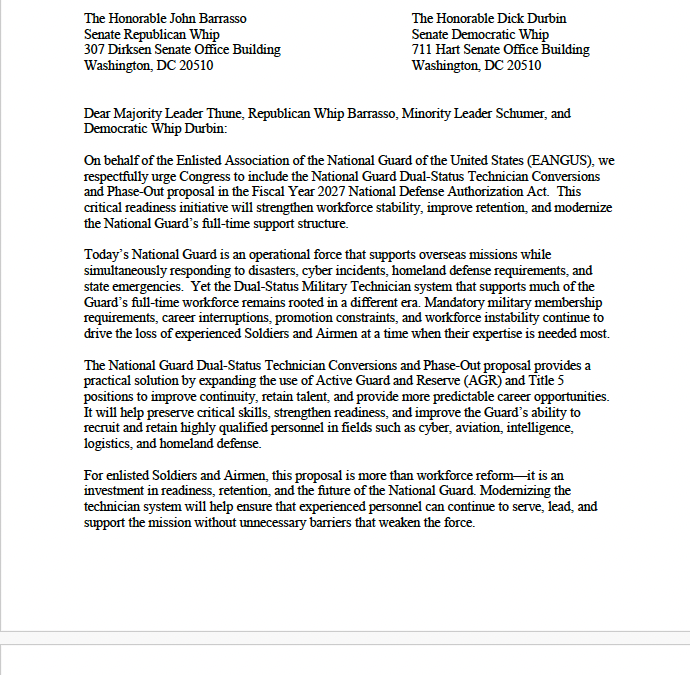
The Enlisted Association of the National Guard of the United States (EANGUS) has formally expressed its support for Legislative Proposal 291 (LP291), the National Guard Dual-Status Technician Conversions and Phase-Out proposal, by submitting letters to Congressional leadership and the House and Senate Armed Services Committees as part of the Fiscal Year 2027 National Defense Authorization Act (NDAA) process.
For decades, Dual-Status Military Technicians have served as a critical component of the National Guard’s full-time support workforce. These dedicated Soldiers and Airmen provide continuity, expertise, and daily mission support that enable the Guard to execute its federal and state missions. However, the technician system was designed for a different era and has increasingly struggled to meet the demands of today’s operational National Guard.
Modern Guardsmen are routinely called upon to support overseas contingency operations, homeland defense missions, disaster response, cyber operations, and state emergencies. Yet the current technician structure continues to present challenges related to mandatory military membership requirements, career interruptions, promotion limitations, workforce instability, and retention of highly experienced personnel.
LP291 seeks to address these longstanding concerns by expanding the use of Active Guard and Reserve (AGR) and Title 5 positions while gradually transitioning away from portions of the existing Dual-Status Technician structure. The proposal aims to improve workforce stability, preserve institutional knowledge, strengthen readiness, and create more predictable career opportunities for National Guard personnel.
In letters sent to congressional leaders, EANGUS emphasized that the proposal represents a practical workforce modernization initiative that will help the National Guard recruit and retain highly qualified personnel in critical fields such as cyber operations, aviation, intelligence, logistics, and homeland defense. EANGUS also noted that improving continuity and reducing barriers to service will better position the Guard to meet the complex mission requirements of the future.
“Today’s National Guard is an operational force serving our nation around the world while responding to emergencies here at home,” said EANGUS President Josh J. Baker. “We must ensure our personnel systems evolve to support the force we have become. LP291 represents an important step toward improving readiness, retaining talent, and providing better career opportunities for the Soldiers and Airmen who serve our states and nation.”
EANGUS recognizes that, like many major legislative initiatives, questions remain regarding implementation details and long-term execution. However, the Association believes the proposal aligns with longstanding EANGUS advocacy efforts focused on technician reform, workforce modernization, and strengthening support for National Guard personnel.
As Congress continues deliberations on the FY27 NDAA, EANGUS will remain actively engaged with lawmakers, National Guard leadership, and partner organizations to ensure the voices of enlisted Soldiers and Airmen are heard throughout the legislative process.
The Association remains committed to advocating for policies that improve readiness, strengthen the force, and enhance the quality of life and career opportunities for National Guard members and their families.
Copies of the letters are attached below.